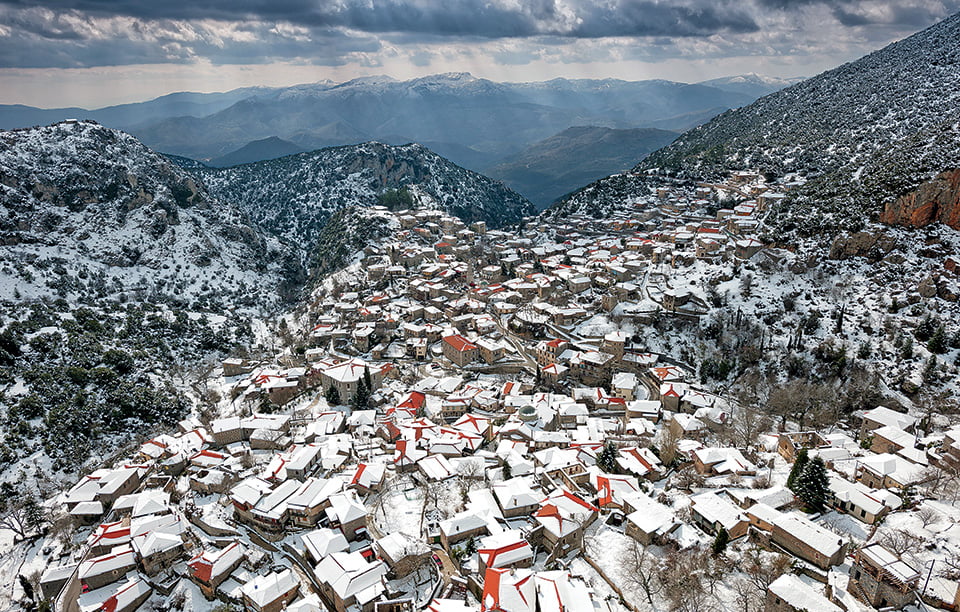
Stemnitsa
Stemnitsa is one of the most important traditional settlements in the Peloponnese. Built at an altitude of 1,050 meters on the slopes of Mount Klinitsa, it has around 120 residents. It is also known as Ypsounta, believed to be built on the same site as the ancient city of the same name, founded by Ypsous, son of Lycaon. However, it is more widely known by the name Stemnitsa.
Traditionally, the inhabitants of the areas around the Lousios River were exceptional craftsmen, which is why during Ottoman rule and into the early 20th century, Stemnitsa flourished as a center of silversmithing and trade. When the Greek War of Independence began, Stemnitsa continued to play an important role as the first seat of the Peloponnesian Senate.
Today, visitors will find a village full of fine architectural elements—simple yet sturdy. The buildings are made almost exclusively of stone and wood, whether single-story elongated houses, two-story homes with “upper and lower floors,” or even facades that appear five-stories tall due to the sloped terrain. Many of these beautiful homes are now closed, visited mainly during summer by their owners, while some have fallen into ruin—but not enough to tarnish the overall charm created by the well-preserved mansions.
While in Stemnitsa, be sure to visit the Folklore Museum, which houses a rich collection of historical artifacts. Some of the most striking buildings include the Nikopouleio Cultural Center, the Trikolonio Hotel built in 1854, and the impressive Silversmithing School building. Also worth seeing are the chapel of Saint Nicholas, renovated in 1859, and the church of Panagia Baphero, built in 1640 within the Castle area. Lastly, don’t miss the small monastery of Zoodochos Pigi, where the First Assembly of the Peloponnesian Senate took place.
Between Dimitsana and Stemnitsa lies the Monastery of Saint John the Baptist, dramatically built into a vertical cliff. To visit, you’ll need to hike for at least 10 minutes. According to tradition, the monastery was founded in the 12th century by Manuel Komnenos on the site of a small hermitage. It has been operating continuously ever since. The frescoes date back to the 16th century, and the rest of the interior decoration to the 17th century. The monastery buildings, including the guesthouse built in 1860, are in very good condition, although some have undergone modifications from their original form.